Rent Repayment Orders in 2026
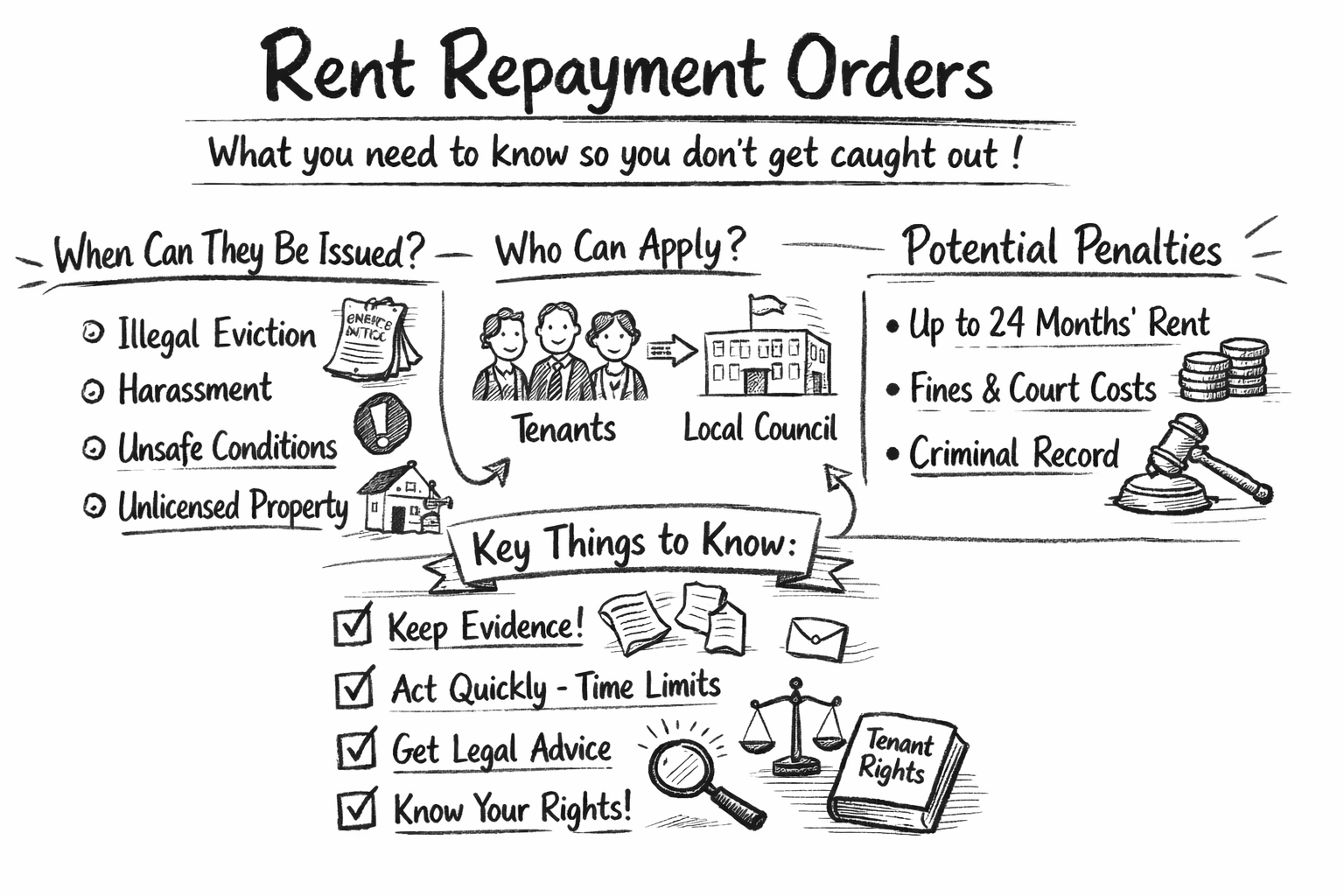
How they work now, and why the Renters’ Rights Act 2025 raises the stakes for Landlords
Rent Repayment Orders (“RROs”) have been around for years, but they’re moving from “niche enforcement tool” to something every landlord and letting agent needs to take seriously. Historically, most RRO claims centred on a familiar set of compliance failures (especially licensing). From 1 May 2026, the Renters’ Rights Act 2025 changes the landscape in ways that make RROs easier to pursue, more valuable to tenants, and potentially more likely to land on a wider range of “landlord” targets.
Below is some useful information to explain what an RRO is, when you can face one, who can bring a claim, who decides it, how much it can cost and why the risk profile looks sharper once the new rules are live.
What is a Rent Repayment Order?
A Rent Repayment Order is a legal order requiring a landlord who has committed certain specified housing offences to repay rent. It can require repayment of:
rent paid by a tenant, and/or
the housing costs element of Universal Credit / Housing Benefit (usually recovered by the local authority).
It is not a “general compensation” scheme for disrepair or poor service. It is offence-driven: no relevant offence, no RRO.
Who can apply for an RRO, and who makes the order?
Who applies:
Tenants (and certain licensees) can apply to recover rent they personally paid.
Local housing authorities can apply where public funds paid the rent (UC housing element / Housing Benefit), and they must follow a notice procedure first.
Who decides:
The order is made by the First-tier Tribunal (Property Chamber) (not “the council” and not “the police”).
Conviction not required:
A landlord doesn’t have to have been convicted in the criminal courts, but the Tribunal must be satisfied beyond reasonable doubt that the relevant offence was committed (a high standard).
The “classic” RRO landscape: How claims have typically worked
Under the current regime (built around the Housing and Planning Act 2016), RROs have usually been most common where there is a clear compliance breach with documentary proof, especially licensing.
The core “traditional” offences that can trigger an RRO include:
Managing or controlling an unlicensed HMO (Housing Act 2004, s.72)
Managing or controlling a property that should be licensed but isn’t (Housing Act 2004, s.95)
Illegal eviction or harassment (Protection from Eviction Act 1977, s.1)
Using or threatening violence to gain entry (Criminal Law Act 1977, s.6)
Failure to comply with an improvement notice (Housing Act 2004, s.30)
Failure to comply with a prohibition order / emergency prohibition order (Housing Act 2004, s.32)
Breach of a banning order (Housing and Planning Act 2016, s.21)
That list explains why licensing failures have been such a common RRO battleground: they’re often “binary” (licensed or not), time-bounded and easier to evidence than more subjective disputes.
When are you “at risk” of an RRO?
You’re exposed when all of the following are true:
A relevant offence has been committed (one of the listed offences, plus any new offences added under the 2025 Act when in force).
The offence relates to the tenant’s home (or a property in the authority’s area, for council applications).
The application is brought in time:
historically this has been within 12 months of the offence for tenant claims (and similar timing constraints for councils serving notices),
but the Renters’ Rights Act 2025 expands key time windows (see below).
How much can an RRO cost?
Current position (Pre–1 May 2026)
The Tribunal can award up to 12 months’ rent (or the relevant housing benefit/UC housing element), with rules around what rent can be counted and potential deductions (for example, where “rent” includes utilities that solely benefited the tenant).
What changes under the Renters’ Rights Act 2025
The Government’s published guidance is clear that the reforms are designed to strengthen RROs by:
doubling the maximum award (from 12 to 24 months),
ensuring repeat offenders pay the maximum, and
expanding who can be targeted (more on that next).
The intent is obvious: bigger potential awards make claims more attractive to bring (and more commercially viable for tenant-side advisers).
The big shift: who can be “The Landlord” for RRO purposes
Historically: Usually the immediate landlord only
Under the existing regime, RROs have generally been pursued against the tenant’s direct / immediate landlord. The law has been criticised for how it played out in “rent-to-rent” structures (where an intermediary leases a property then sublets it).
Under the Renters’ Rights Act 2025:
The Government’s guide says the Act will extend RROs to superior landlords and company directors explicitly to improve accountability where criminal rent-to-rent or complex structures have been used.
Practical takeaway: if you’re the property owner sitting “above” an intermediary, you’ll want to treat RRO risk as something you can’t automatically contract away. You will still be liable.
New offence triggers: Why RROs may become more common after 1 May 2026
A major reason RROs may become more frequent is that the Act extends the RRO regime to new offences, not just the “classic seven”.
The Government’s own summary highlights new RRO-linked offences around:
knowingly or recklessly misusing a possession ground
breaching restrictions on letting or marketing a property (where the Act imposes a restricted period)
ongoing non-compliance connected with new PRS systems, including issues tied to the PRS Database and landlord redress/ombudsman compliance (including continued non-compliance after financial penalties)
Different commentators also flag that, in combination with stronger standards enforcement, the scope for tenant-led enforcement grows (because the “trigger” is no longer limited to licensing and the most obvious criminal offences).
Why landlords could be more exposed in practice
Even if you run a decent operation, these reforms increase the number of “tripwires” that can turn into an RRO claim:
Higher value claims (up to 24 months)
Bigger awards mean more tenants will explore it, and more advisers will take cases on.Longer time to bring claims
The policy direction is to give tenants longer to act (moving from a short, “act fast” window to a more realistic one).Wider target pool (superior landlords / directors)
Ownership and corporate structures may no longer shield the person with ultimate control.New offence categories linked to the reformed renting system
If possession processes and new PRS compliance systems create offences that can trigger RROs, you can expect more claims to be pleaded creatively alongside (or instead of) other disputes.
What landlords and agents should do now
If you want to reduce RRO risk ahead of May 2026, focus on the areas most likely to produce clear evidence trails:
Licensing audit: confirm whether each property is licensable (HMO / selective licensing), and keep renewal dates diarised.
Possession discipline: ensure possession grounds are used correctly, documented, and not “weaponised” (the Act specifically targets misuse).
Documentation hygiene: keep records that prove compliance steps, dates, notices, inspections, repairs, and communications.
Supply chain checks (rent-to-rent / management arrangements): do due diligence on intermediaries and monitor how the property is being let and advertised.
Stay aligned with official guidance: the UK Government has already published RRO guidance anticipating the new rules and a start date of 1 May 2026.
The 10 things that could catch you out
-
Section 72(1) of The Housing Act 2004
This means renting out a property that should be licensed as an HMO, but is not.
In simple terms:
If your property is a House in Multiple Occupation and the law says it must have a licence, it is a criminal offence to let it without one. -
Section 95(1) of The Housing Act 2004
This applies where a property is in an area covered by selective licensing, and you let the property without the required licence.
In simple terms:
If your council requires a licence for single-let homes in that area and you rent without one, you are committing an offence. -
Section 30 (1) of The Housing Act 2004
An Improvement Notice is issued by the council when a property has hazards or serious disrepair.
In simple terms:
If the council tells you to carry out certain works and you do not do them within the required timescale, this is an offence. -
Section 32 (1) of The Housing Act 2004
A Prohibition Order stops a property (or part of it) from being used.
In simple terms:
If the council says a property must not be occupied (or must not be used in a certain way) and you still allow it to be used, you commit an offence. -
Section 1 (2), (3) & (3a) of the Protection From Eviction Act 1977
This covers removing a tenant without following the proper legal process, or pressuring them to leave.
In simple terms:
You commit an offence if you:force a tenant out without a court order, or
make their life so difficult (threats, repeated visits, cutting services, intimidation) that you are effectively trying to push them out.
-
Section 6 (1) of The Criminal Law Act 1977
This offence is about using force to enter a property when someone inside is objecting.
In simple terms:
If you force your way into a property (for example by breaking a door or window) when the occupier is present and does not consent, that can be a criminal offence – even if you own the property. -
Section 21 of The Housing and Planning Act 2016
A banning order prevents someone from letting property or engaging in letting or property management.
In simple terms:
If a person who is subject to a banning order still lets or manages property, they commit a further offence. -
Section 16J (1) of the Housing Act 1988
This relates to using certain eviction grounds when you should not be using them.
In simple terms:
If you use an eviction ground and you either:know it is not true, or
do not properly check whether it is true,
you may commit an offence.
For example, claiming you need the property back for a reason that is not genuine.
-
Section 16J(2) of the Housing Act 1988
his applies where a landlord uses a possession ground based on:
moving into the property themselves, or
selling the property.
In simple terms:
If you evict a tenant saying you are going to move in or sell, and then re-let or advertise the property within 12 months instead, you commit an offence (unless a valid exception applies). -
Section 16J(3) of the Housing Act 1988
This offence is about ongoing failure to comply with certain legal duties introduced by tenancy reform.
In simple terms:
If you repeatedly or continuously fail to comply with key legal requirements placed on landlords (rather than a one-off mistake), this can become an offence in its own right.It is aimed at landlords who consistently ignore their legal obligations.
Bad landlord conduct
Some examples of what may be considered bad landlord conduct are described below.
Failure to make repairs
This is where the landlord fails or is slow to deal with problems about the property they had been made aware of. Problems include but are not limited to:
damp and mould
leaks
fire-safety concerns
broken heating
pests
There is a well-known principle: “If it isn’t written down, it didn’t happen.”
In practice, this is often true.
When a dispute arises, being able to demonstrate what was said, what actions were taken, and when those actions were taken can be critical. Accurate records of your communications, responses and attempts to resolve issues provide objective evidence of your conduct and decision-making.
Maintaining a clear audit trail will place you in a far stronger position should any allegation or complaint be made, and can be the key factor in protecting you if a tenant or third party later seeks to challenge your actions.
Failure to send correct documentation
This is where the landlord fails or is slow to send all the information the tenant needs at the start of the tenancy. Documents include:
electrical and gas safety certificates
Energy Performance Certificate
written statement of terms
tenancy agreement
Fire hazards
Fire hazards include but are not limited to:
a lack of fire doors in an HMO
no smoke alarm
key lock on the inside of the front door or bedroom door in an HMO (as opposed to the safer thumb lock)
Harassment, aggression or intimidation
This includes:
trying to get the tenant(s) to leave the property without following the proper process
entering the property without giving notice
raising rent without following the correct process
threatening behaviour
behaving in a way that could make the tenant leave
Non-compliance with other laws
This may include:
asking for or accepting a higher rent than advertised
failure to give good reason for not allowing a pet
discrimination against the tenants for any of the protected characteristics
Good landlord conduct
Examples of good landlord conduct include:
responding to complaints about the property and making acceptable repairs
providing all the correct documents at the start of the tenancy
complying with all other laws
Summary
Rent Repayment Orders started as a powerful but relatively targeted sanction, often arising from licensing failures and serious misconduct. The Renters’ Rights Act 2025 is designed to make them more potent (up to 24 months’ rent), easier to pursue (longer time limits) and applicable against more people (including superior landlords and company directors), with new offence triggers connected to the reformed PRS framework.
If you’re a landlord, the message is simple: RROs are no longer a niche risk for “bad actors” only. They’re becoming a mainstream compliance exposure and the best defence is getting your licensing, paperwork and processes watertight before May 2026.