Selective Licensing The Proposal…
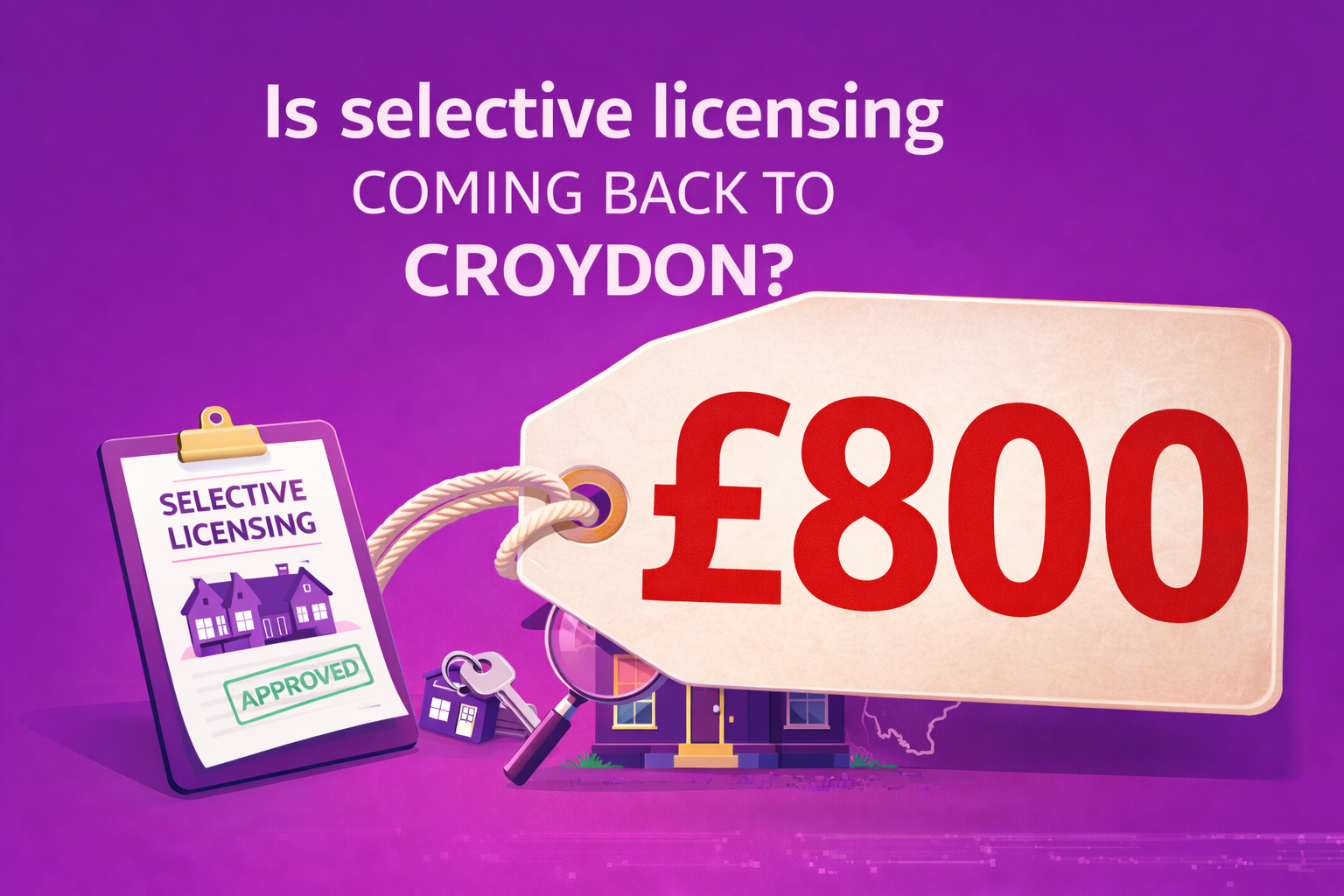
The reality of the proposal:
Just when many landlords thought Selective Licensing in Croydon had been quietly laid to rest, it appears it may be making an unexpected comeback — and, unsurprisingly, with a higher price tag.
For those who read my previous blog, you’ll recall that when Selective Licensing was in place between 2015 and 2020, the fee stood at £750 per property. Fast forward to today, and the current proposals suggest landlords may soon be paying even more for the privilege.
It seems Selective Licensing hasn’t just returned — it’s returned with inflation fully accounted for.
If you’d like a refresher on how the previous scheme played out, you can read my earlier blog post above.
I completed the Survey and Here’s a few Additional Facts:
I’ve taken the time to complete the consultation survey and have my say, drawing on my own experience of Selective Licensing when it was previously introduced back in 2015. In my view, the scheme at that time served little real purpose. It generated cost, paperwork and frustration for compliant landlords, but did very little to address the small number of genuinely poor-quality properties it was supposedly designed to target.
What may surprise many landlords is the level of fees now being proposed.
Under the current consultation:
A single selective licence is proposed at £800 per property
If you own a HMO in the borough of Croydon, the proposed fee rises to £1,250 per property
To put that into perspective, if you own 10 properties in Croydon, that’s £8,000 in licence fees alone — before you’ve improved a single property or received any tangible service in return.
Pause for a moment and think about that.
When you pay that sort of money and receive no meaningful service, no improvement in enforcement, and no visible uplift in housing standards, you’re entitled to ask: what exactly are we paying for?
I’m not yet sure where the consensus among landlords will land — whether the majority will be for or against the proposals — but I suspect many will share similar concerns once the figures are fully understood.
To be clear, I do agree that regulation has a place. There are poor properties out there, and there are landlords who do not meet acceptable standards. However, from years of experience, I firmly believe that these cases are the exception, not the rule.
The vast majority of landlords provide safe, decent, well-maintained accommodation, and they already comply with a growing list of legal and regulatory obligations.
Which raises a fair question:
Why not target the problem landlords and poor properties directly?
They are few and far between. They are often already known to local authorities. Targeting them in isolation would surely be:
More effective
Easier to police
Fairer on compliant landlords
And significantly cheaper for everyone involved
Blanket schemes, by contrast, simply penalise good landlords while the worst offenders often continue to operate regardless.
What I fed back in the consultation
In my response to the survey, I raised several key points, including:
That selective licensing should be intelligence-led, targeting known problem properties rather than applying a borough-wide charge
That compliant landlords should not be repeatedly charged for schemes that deliver no measurable improvement
That enforcement resources would be better spent on proactive inspections of known offenders
That licence fees at this level risk discouraging investment in the borough and ultimately reducing the supply of good-quality rental homes
And that any scheme introduced should come with clear, transparent outcomes, so landlords can see what their money is actually funding
If you’re a landlord in Croydon, I would strongly encourage you to engage with the consultation and submit a response. Whether you support or oppose the proposals, this is one of those moments where silence will simply be taken as acceptance.
A closer look at the proposed fees (and the discounts)
As you might expect, the proposed licence fee is to be split into two parts: Part A and Part B — because one payment is never quite enough.
Part A is the application fee, payable upfront on submission. This covers the cost of processing the application and the administrative work involved in deciding whether it is eligible. Should the application be refused, rejected, or withdrawn for any reason, this fee will not be refunded. In short, once Part A has left your bank account, it will not be making a return appearance.
Part B becomes payable once the application has been assessed and the council decides to grant the licence. This portion is intended to cover the administration, management, and enforcement of the licensing scheme for its duration.
Two payments. Both mandatory. Both administrative.
Could You Be Refused A Licence?
Here are the key reason’s you might be refused a license.
1. You Fail the “Fit and Proper” Test
Councils look closely at you, not just the property. Past issues such as:
Housing law breaches
Enforcement action or fines
Poor management history
can all lead to refusal — even if they happened years ago.
See the definition or guidance for the “Fit and Proper Person Test’’
2. The Property Isn’t Up to Standard
If the property isn’t safe, the licence won’t be granted. Common deal-breakers include:
Fire safety failures
Serious hazards
Inadequate gas or electrical compliance
Overcrowding
No licence means no legal letting.
3. Your Application Is Wrong or Incomplete
Missing documents, incorrect details, or failure to disclose past issues are quick ways to get refused. Councils take accuracy seriously — and so should you.
4. You’ve Applied for the Wrong Licence
If the property actually needs an HMO or additional licence, a selective licence application will be rejected outright.
5. Planning Issues Trip You Up
Licensing does not override planning law. If the property doesn’t have the correct planning consent, expect problems.
Bottom Line
Most selective licence refusals are avoidable. Get the paperwork right, keep the property compliant, and don’t underestimate how closely councils scrutinise both landlords and homes.
Incentives / Available Discounts (use the term loosely)
In line with the current enthusiasm for all things energy efficiency, the proposal also seeks to encourage higher EPC ratings. To that end, landlords whose properties achieve an EPC rating of B or above may be eligible for a £50 discount.
A welcome gesture, no doubt — albeit one that makes a relatively modest impression when set against an £800 licence fee.
There is also a proposed discount for accredited landlords. Accreditation, of course, comes at a cost of its own, meaning that once the numbers are run, the saving may exist more in theory than in practice.
Lastly, landlords with multiple properties are offered a £100 discount. While every little helps, those with larger portfolios may observe that this reduces the overall bill by just enough to notice — but not enough to materially change it.
Comparison Chart
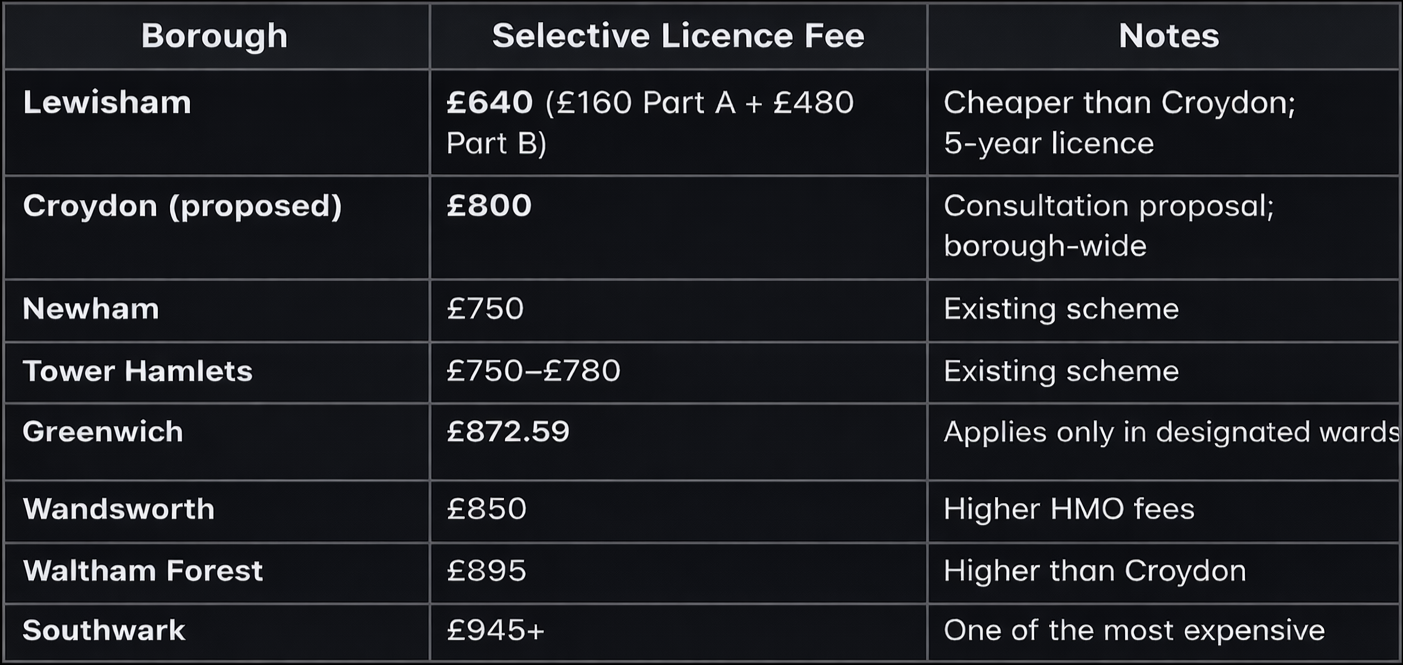
And if you’re wondering what counts as “accredited”…
Croydon Council’s proposals also reference a number of landlord and agent accreditation schemes. If you’re a member of one of the following, you may be entitled to a £100 discount from Part B of the licence fee.
For completeness, it’s worth also looking at what these memberships typically cost.
Landlord accreditation schemes
London Landlord Accreditation Scheme (LLAS)
Approx. £125–£175 (depending on training route)National Residential Landlords Association (NRLA)
Approx. £85–£99 per yearUK Association of Letting Agents (UKALA)
Approx. £300–£400 per year
Professional agent memberships
Association of Residential Letting Agents (ARLA / Propertymark)
Approx. £300–£600+ per yearRoyal Institution of Chartered Surveyors (RICS)
Approx. £600+ per year, before any additional compliance costsSafeagent
Approx. £300–£400 per year
So while a £100 discount is technically available, it’s fair to say that in many cases the cost of qualifying for that discount comfortably exceeds the saving itself.
Which rather neatly brings us back to the same conclusion: the discount exists, it just doesn’t always exist economically.
Whether that feels reassuring or merely well-spaced out is, of course, a matter of perspective.
On the plus side (and this is the genuine upside), once granted, the licence lasts for five years. Which means you only need to go through the process, paperwork, and associated fees once every half-decade.
Last chance to have your say
The 12-week consultation ends today Monday 12 January 2026, and is available on M.E.L Research’s website.