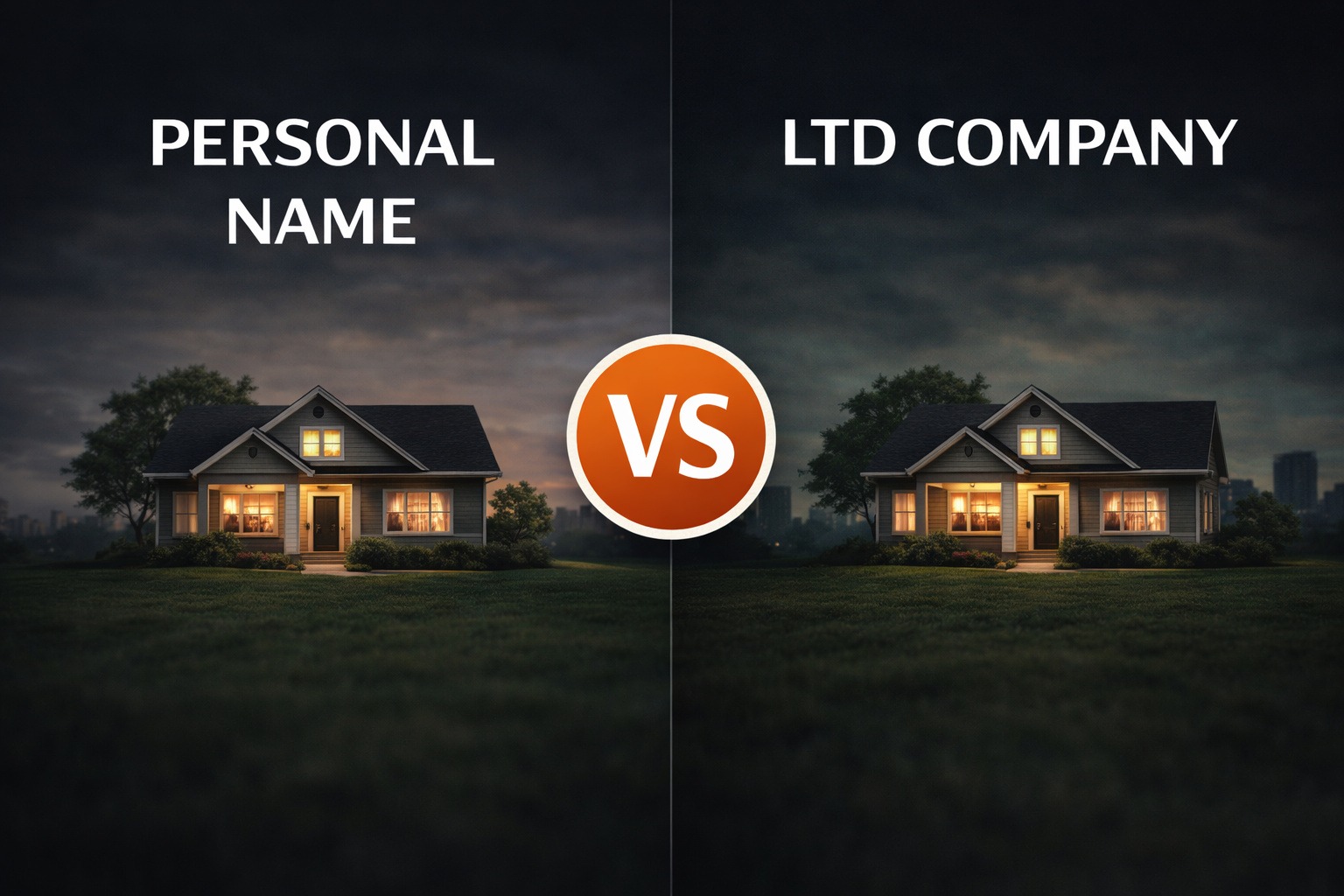
Holding Property in a Personal Name vs a Limited Company
Compliance Costs - Where Does It End
What Landlords Need to Understand
One of the most common questions landlords ask is whether it still makes sense to hold rental property in a personal name, or whether operating through a limited company is now the better option.
There’s no one-size-fits-all answer but the differences between the two structures have become far more important in recent years.
Below is a clear breakdown of how each works, the pros and cons, and why many landlords are reconsidering how they hold their property.
Personal Ownership: The Traditional Route
Most landlords historically bought property in their own personal name. It’s simple, familiar, and often cheaper to set up initially. Often this was a favourable option, that was until April 2017 when the Section 24 was introduced.
Advantages of Personal Ownership
Simpler structure
No company accounts or corporation tax returns
Easier mortgage arrangements (historically)
Often lower interest rates than company buy-to-let mortgages
The Big Issue: Section 24
The major downside of personal ownership is now Section 24, which restricts how mortgage interest is treated for tax purposes. If you dont know what the Section 24 is, you can read the legislation here: https://www.legislation.gov.uk/ukpga/2015/33/section/24
In simple terms:
You cannot fully deduct mortgage interest from rental income
Instead, you receive a 20% tax credit on the interest paid
Higher-rate and additional-rate taxpayers are hit the hardest
As a result, many landlords appear profitable on paper while operating cash-flow negative in practice, particularly where borrowing levels are high. This is because tax is calculated on the full rental income, even though the landlord does not actually retain that amount once financing costs are taken into account.
Limited Company Ownership: Increasingly Popular
Holding property through a limited company has grown significantly, particularly among portfolio landlords and higher earners.
Advantages of Limited Company Ownership
Mortgage interest is fully deductible as a business expense
Profits are taxed at corporation tax rates, not income tax
Greater flexibility around retaining profits in the business
Often better suited for long-term portfolio growth
For landlords with higher borrowing levels, this structure can significantly improve cash flow after tax.
The Trade-Offs of a Limited Company
While tax treatment is often better, company ownership isn’t without cost.
Disadvantages to Consider
Higher mortgage interest rates and fees - Marginal
Accounting and company administration costs
Corporation tax on profits
Additional tax when extracting money personally (dividends or salary)
More complex exit strategy if selling
In short: tax efficiency improves, but complexity increases.
In my opinion, a limited company structure is often the more tax-efficient option. This does not necessarily apply where landlords are looking to incorporate existing personally owned properties, as there are important tax and cost considerations. For new property purchases, however, a limited company may offer a more favourable starting structure. The mortgage fees are not worlds apart and i’ve always found the accounting costs to be reasonable.
Why This Decision Matters More Now
Several factors have pushed this debate to the forefront:
Section 24 has now been fully phased in
Interest rates have risen sharply compared to historic lows
Compliance costs are increasing
Profit margins are tighter than they once were
As a result, the way a property is held can now materially affect whether it remains viable. If property investment is a secondary source of income and you are already a higher-rate taxpayer, a significant portion of your rental income may be lost to taxation.
Should You Transfer Properties Into a Company?
This is where landlords need to be careful.
Moving property from personal ownership into a limited company (aka Incorporation) is treated as a sale, which can trigger:
Capital Gains Tax
Stamp Duty Land Tax
Refinancing costs
In many cases, the upfront tax costs of transferring a property can outweigh the longer-term benefits but you really should do the maths. This is particularly relevant for landlords who for example may have purchased their rental properties prior to 2008, these landlords may have experienced substantial capital growth in this time. In such cases, the resulting capital gains tax liability can be significant, and transferring the property into a limited company would also trigger stamp duty land tax, which depending on the property value may be considerable.
As a result, it can take many years before any financial benefit from incorporation is realised. For this reason, most landlords who move towards company ownership tend to do so by:
Purchasing new properties via a company, or
Running a mixed portfolio (some personal, some company-owned)
Professional tax advice is essential before making any changes.
Which Structure Suits Which Landlord?
As a broad rule of thumb:
Lower-rate taxpayers with low borrowing often remain better suited to personal ownership - BUT if this position changes in the future it may no longer suit you.
Higher-rate taxpayers with significant mortgages often benefit more from company ownership
Long-term investors focused on growth tend to prefer company structures
Accidental or single-property landlords often stay personal
But the numbers matter more than the theory.
Summary
There is no universally “better” option, only what works best for your circumstances.
What has changed is that holding property in a personal name is no longer automatically the most efficient route, particularly where borrowing and tax rates are high.
Landlords should:
Understand how tax is actually being calculated
Look at net cash flow, not headline profit
Factor in long-term plans, not just the next tax year
And most importantly, take advice before restructuring.